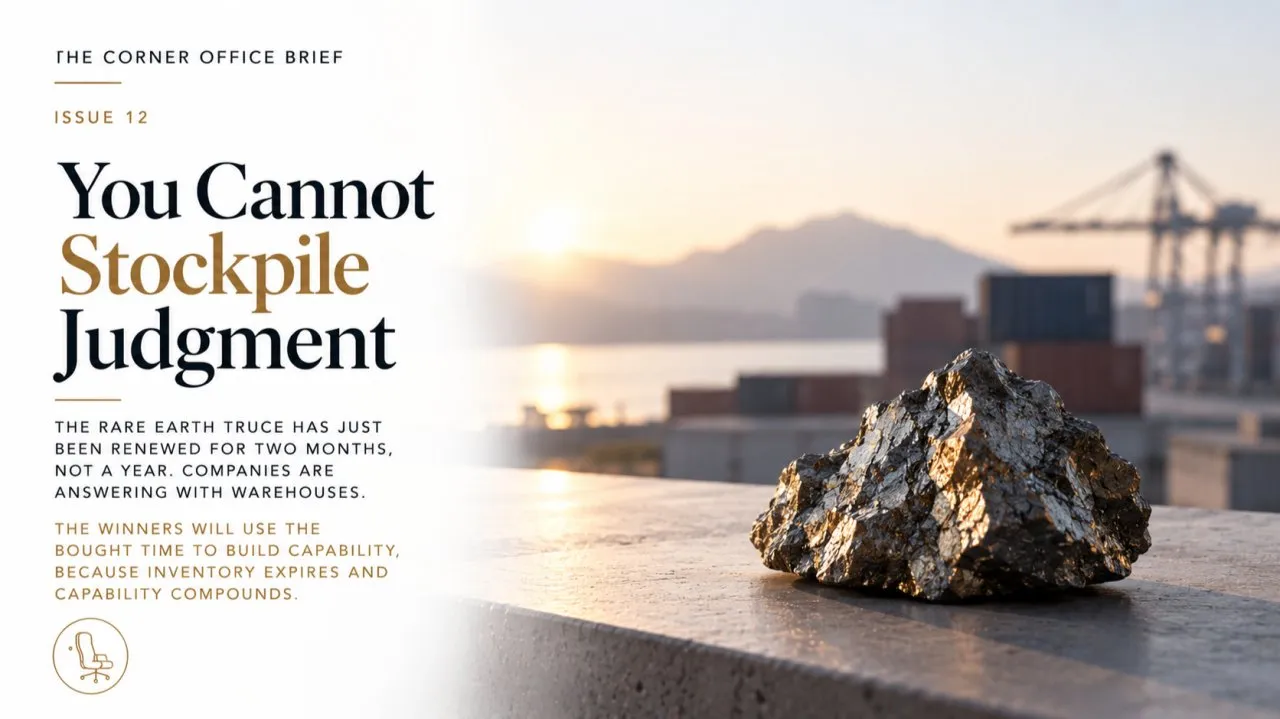
The truce keeping the world's most contested industrial materials moving has been renewed for two months, not a year. Companies are answering that uncertainty with warehouses. The winners will be the companies that treat the bought time as a window to build, because inventory expires and capability compounds.
In September 2010, a Chinese trawler collided with two Japanese coast guard vessels near islands both countries claim. Japan arrested the captain. Within weeks, Japanese manufacturers noticed something that was never announced: rare earth shipments from Chinese ports had stopped clearing customs. Beijing denied that any embargo existed. The paperwork simply never moved.
Shipments crept back within months, and prices for several of the metals multiplied over the following year. Japan, which was then buying roughly nine in every ten tonnes of its rare earths from China, drew the obvious conclusion. This would happen again.
What Japan did next is the supply-chain story I retell most often, because half the world is now copying Japan's problem, and almost nobody is copying its answer.
The two-month world
Sixteen years later, the same lever has been pulled worldwide at once, then half-released.
Last October, Beijing announced its most sweeping export controls yet on rare earths and the technology that processes them, reaching listed categories of foreign-made products with as little as 0.1 percent Chinese rare earth content by value. Rare earths sit inside high-performance electric motors, wind turbines, hard drives and aircraft. The International Energy Agency estimates that full enforcement could put about 6.5 trillion dollars a year of production outside China at risk, across cars, electronics, defense and energy.
In late October 2025, the two presidents met in Busan: China suspended the new controls for a year, Washington lowered some tariffs in return. In late September, as President Xi began a state visit to Washington, the US Treasury Secretary announced the renewal. Not a year. Two months. The suspension now runs to January 10, ninety days from this morning.
The materials inside the world's most capable motors now move on a lease measured in months. Even under the truce, an older licensing regime covering seven medium and heavy rare earths never paused. By May, Reuters reported that Japan had received 4 percent of the dysprosium it imported in the year before the controls, Germany none, and that manufacturers were paying 1.5 to 3 times more for magnets, according to Benchmark Mineral Intelligence.
So boards did what boards can do by Friday. They bought inventory.
Rented resilience
September was the largest September for US container imports on record, on Descartes' count, with volumes from China up 21 percent year over year: a pattern consistent with buyers holding goods rather than promises, whatever mix of tariffs and metals drives each order.
What all of this buys deserves a name on the risk register. Call it rented resilience: continuity that depends on someone else's decision and expires on someone else's calendar. A truce is rented. A license is rented. A waiver is rented. A warehouse full of magnets is rented too; it simply has a longer lease. None of it is worthless. All of it runs out.
The case for the warehouse
Let me argue for the stockpilers first, because they are right within a ninety-day window.
You cannot pour a separation plant in ninety days. You cannot qualify a new supplier of a controlled material in ninety days, and for some of these metals no second supplier exists: the first commercial production of separated heavy rare earths outside China began only in May 2025 at a Lynas plant in Malaysia. With so little time, inventory is the only lever most companies can move. It is also cheap relative to what it protects: the IEA costed a strategic stockpile of the eleven high-risk materials it assesses at under 900 million dollars a year, net, for the buying countries. Against trillions of exposed production, that is not a hard decision.
Which is exactly the problem. The stockpile is cheap, fast, and visible, so it is what gets funded, reported, and mistaken for the job. The villain of this story sits in neither Beijing nor Washington. It is the budget line. Inventory books as an asset this quarter. People can make inventory unnecessary book as salary, year after year, before they prove anything. Given one budget and one annual cycle, a rational CFO funds the warehouse and defers the team. Those rational choices add up to a corporate world insured for the next ninety days and uninsured for the next decade.
What Japan actually bought
Japan faced the same choice in 2010, with less warning, and chose differently.
Japan stockpiled, of course. But it treated the stockpile as a bridge, not a destination, and spent the time it bought on things that compound. Within six months, the state agency JOGMEC and the trading house Sojitz had invested $ 250 million in the Australian producer Lynas, reserving 8,500 tonnes a year for Japan for a decade. Manufacturers set engineers to redesign magnets to need less of the scarcest inputs: by 2018 Toyota had announced a heat-resistant magnet using no dysprosium or terbium, and up to half the usual neodymium. A 2022 law named critical materials a national priority and assigned them owners.
The result took a decade. By 2020, China's share of Japan's rare earth imports had fallen below 60 percent. Not independence. Options. When the lever was pulled again last year, Japan was still exposed, almost entirely on a few heavy rare earths, but it had somewhere else to stand.
The asset Japan built was never really the tonnage. It was a generation of engineers, buyers and officials who owned the problem by name and were allowed to work on it for fifteen years.
The bench behind the build-out
That build-out has now gone global, which is where this becomes a hiring story.
India approved an 820 million dollar rare earth magnet manufacturing scheme last November. The Pentagon took a 400 million dollar equity stake in MP Materials, the largest American producer, with a ten-year floor price for its magnet feedstock. Europe is paying tuition meanwhile: heavy rare earth prices there ran about five times Chinese levels in mid-2026, on the IEA's figures. Every one of those announcements is a plant or a program. Every plant and program will need a leadership team that mostly hasn't been hired yet.
Here is the shortage underneath the shortage. A buyer of controlled materials doesn't run procurement as the textbooks teach: one dominant seller, barely a spot market, and a license queue that moves for political reasons. The executives who can work that problem combine three things that rarely meet in one CV: deep process knowledge, commercial judgment under scarcity, and the ability to read policy the way a treasurer reads interest rates. The pool is so shallow that the two flagship American magnet ventures spent this summer in court over one senior engineer and seven colleagues, and an 86-year-old consultant tells companies hunting separation expertise to "start with the cemeteries, then check assisted care," on Bloomberg's reporting. Every company and government now announcing a plant is recruiting from that pool, at once.
What I see from the search desk
The word resilience now appears in nearly every operations and procurement brief that reaches my desk, across Asia and Europe alike. The budget behind the word is usually an inventory budget. When we map candidates, we hunt hardest for the line that isn't who managed a shortage. It's the engineer who designed a controlled material out of a product, the procurement head who qualified the second source everyone said didn't exist, the plant leader who ran the numbers and told the board which exposure to live with. Regular readers will remember thesis risk. This is the opposite profile: a record that reads as options created. They are the scarcest CVs in my verticals, and the market has not repriced them yet.
If you sit on a board, audit your resilience spending into two columns. Rentals: inventory, truce assumptions, waivers, licenses, anything that expires on someone else's calendar. Equity: qualified second sources, redesigned products, recycling streams, and above all people who own the exposure by name. If the second column is empty, you lack resilience. You have a lease, and you just watched it get shorter. Then fund one thing this quarter that only pays in 2030 and attach a name to it, because Japan's real innovation was continuity of ownership, not any single investment.
If you are an operator or a procurement leader, the advice is the mirror image. The chokepoint you are living through may be the most valuable credential this decade hands you, but only if you convert experience into evidence. Write your record as decisions: what you moved, what you refused to move, what you designed out, what you told the board to stop. A shortage survived is a war story. A shortage ended is a career.
The truce will be renewed in January or it will not, and no operator will control which. The only variable a company controls, and the one that matters in every version of the next decade, is whether the time its warehouses buy is spent or merely passed. Stockpiles are how you survive the next ninety days. People are how you stop living in ninety-day increments. You can stockpile metals, magnets, and finished goods against the day the rules change. You cannot stockpile judgment. You have to make it in advance, by someone who chose to own the problem before it had a deadline.
Free: the Axentia Global Board Guide series. Practical guides to board roles, candidacy and the boardroom. Browse the guides