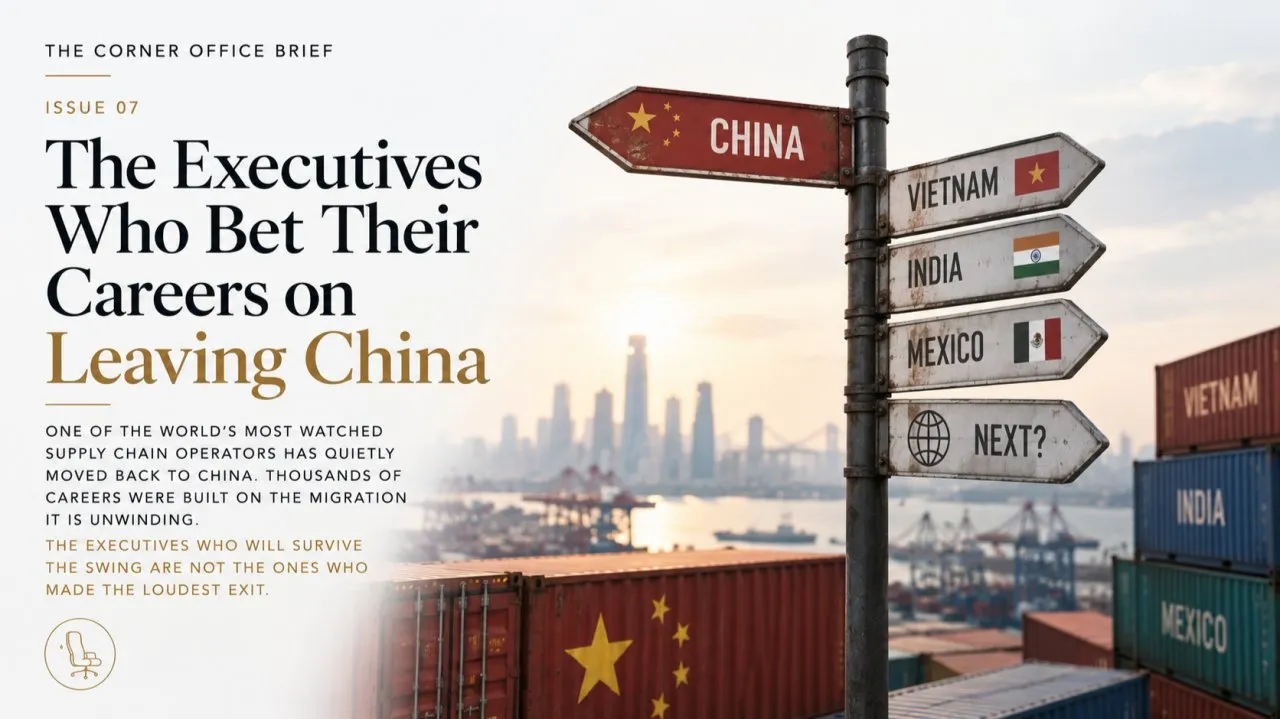
A year ago, one of the world's most-watched supply chain operators made a very public bet on Vietnam.
Shein, the online fast-fashion giant, built its business on the factory ecosystem of southern China: thousands of small suppliers that can turn a design into a shipped garment in days. In 2025, with Washington closing the tariff loophole that had allowed its parcels to enter America, the company leased 15 hectares of warehouse space near Ho Chi Minh City. The size of twenty-one football pitches. It was the defining exit story of the tariff era: if even Shein was leaving China, everyone was.
This August, Reuters reported the ending. The lease has been cut to six hectares. Reporters who visited in late July 2026 found a handful of workers. And in Guangzhou, factory managers described suppliers who had followed the migration to Vietnam coming home. Part of the arithmetic was Washington's own doing: a new US trade action in July 2026 put China and Vietnam under the same 12.5 percent duty, shrinking the gap the move was built on. The rest was the ground itself. Workers in Vietnam proved hard to recruit on Chinese factory terms, and the supplier network could not match southern China's speed on small, fast production runs.
Shein is the loud case. The aggregate data says the traffic is turning with it. This is not really a sourcing story. It is about the people who were hired to run the exit.
The U-turn in the numbers
QIMA, a firm that inspects factories and audits suppliers for Western buyers, has unusually honest data: it measures where companies actually send inspectors, not where they tell conference panels they are going. In the first quarter of 2026, it still showed the exit running: on QIMA's measure, China's share of US sourcing fell to 27 percent, from 30 percent across 2025, while inspection demand across South and Southeast Asia kept surging.
Then came the second quarter. China's share of North American inspection and audit volumes climbed to 35 percent, its highest since 2024. European demand for Southeast Asian inspections swung from growth in April 2026 to decline by June. The container data agrees: Descartes, a logistics technology firm, counted China's share of US container imports rising almost four percentage points in a single month, to about a third in May 2026 — and holding through July, when China-origin volumes hit a one-year high.
What flipped it was that it was not a trade deal. It was fuel. When the Strait of Hormuz closed at the end of February 2026, factories across Vietnam and Bangladesh that depend heavily on imported fuel faced rising energy costs and supply constraints. Chinese plants, powered mostly by domestic coal and renewables, were more insulated from it. Buyers discovered their diversified networks had less redundancy than the slide decks implied. Orders drifted back to the market least affected.
Now hold that chart against the careers.
Thesis risk
For roughly seven years, one sentence has appeared in almost every supply chain, procurement, and manufacturing mandate in my world: get us out of China.
A generation of executives has spent those years building their record on that sentence. The vice president who stood up the Vietnam campus. The procurement head who requalified hundreds of suppliers in India. The manufacturing director who ran the Mexico ramp. Ask them for their proudest achievement, and you will often hear a geography.
Call it thesis risk: a career collateralized against a single corporate bet. It is a concentration these same executives would never accept in their own investment portfolios. But the career version is invisible while the bet is running, because the market rewards it. The specialists get hired faster, paid more, and promoted sooner.
Right up until the thesis turns.
The honest case for the exit
Let me argue against my own alarm first; the counterargument is strong.
Nothing in this data says the diversification push was wrong. The risks that launched it are still live: export licensing on critical materials, a tariff regime that can lurch in a week, a depth of manufacturing capability so concentrated that Beijing has used access to it as leverage. Even after the spring rebound, Descartes' numbers show container volumes from China still about 20 percent below their 2024 peak. And many exits are still underway: Oxford Industries, the American group behind Tommy Bahama, told shareholders it cut China from about 40 percent of its sourcing to 29 percent in a single year, heading for roughly 1 percent. I went looking for a second Shein in filings and earnings calls, and could not find one. A board that abandoned diversification on this evidence would be as reckless as one that never started.
But look at what the reversal actually proved. The diversified network failed a live stress test, and it failed in the dimension almost nobody had hedged: energy. Companies insured themselves against tariffs and politics, only to find themselves exposed to a fuel line. The exit did not fail. It became reversible. This was never a migration with an end date. It is a permanent, two-way management problem.
And a two-way problem needs a different executive than a one-way move.
The mistake was in the mandate
Here is the villain of this story, and it is not the executives.
Boards wrote the mandate as a destination. Get us out of China is a place, not a decision rule. It cannot tell you which product families should move, which moves are reversible, or when to stop. So companies got what they specified: motion. Announced relocations, ribbon cuttings, headline percentages, and a management layer selected and promoted for direction rather than judgment. QIMA's own 2026 sourcing survey found American buyers three times more likely to switch between overseas suppliers than to bring production home. Much of what was sold as resilience was churn.
We have run this film before, in reverse. Twenty-five years ago, the sentence in every mandate was the same, backward: get us into China. That wave made careers too. And when coastal Chinese wages climbed, and the arithmetic changed in the 2010s, the executives who stayed valuable were not the ones with the longest list of factories opened. They were the ones who could stand in front of a board and explain what each part of the network really cost, what could move again, and what a move would destroy—the specialists in a direction aged with the direction. The specialists in the decision did not.
What I see from the search desk
The briefs are already changing shape. In a third-annual 2026 survey of 194 supply chain C-suite executives, fielded in the spring, the top concern was no longer geopolitics, which had dominated for two years. It was execution risk in transformation, at 57 percent, and 69 percent named change leadership the most critical capability in the function. The fear has moved from the reason for the move to the move itself.
The candidates who stand out now answer a different question: not how much of the network they moved, but which move they refused, and how they knew. The sentence I hear least and value most is some version of: we modeled it, the move did not pay, and I told the board to stop. Anyone can join a migration. The scarce executive is the one who can say it has stopped paying, especially after the announcement.
If you built the last seven years of your career on the exit, your asset is not the direction. It is everything the direction taught you: what qualifying a supplier really costs, how long a ramp really takes, where the hidden dependencies sit, what breaks first in a crisis. Rewrite your record as decisions rather than destinations, and include the reversals. A move you stopped, measured and defended is worth more in a boardroom today than a move you completed.
If you run a company or sit on a board, write the next mandate as a decision rule, not a geography. Which threshold triggers a move, which triggers a return, and who owns the model. Then ask every candidate which of their own past moves they would reverse today. The ones worth hiring have a list. The ones who answer "none" are telling you they executed someone else's thesis and will execute the next one too, in whichever direction it points.
Every era hands executives one big sentence, and the sentence always feels permanent. Get us into China. Get us digital. Get us out of China. Get us into AI. Careers concentrate around the sentence, because concentration pays while it lasts.
Companies hedge their bets. The people who execute those bets rarely do.
The corporate thesis will turn again, in some direction none of us is modeling. When it does, the market will rediscover what it learns at every turn and forgets between them: it never needed executives who could move in a straight line. It needed the ones who knew when to turn.
Free: the Axentia Global Board Guide series. Practical guides to board roles, candidacy and the boardroom. Browse the guides