The Disposable CEO
Consumer goods boards are firing chief executives on an eighteenth month clock. The problem is not the executives.

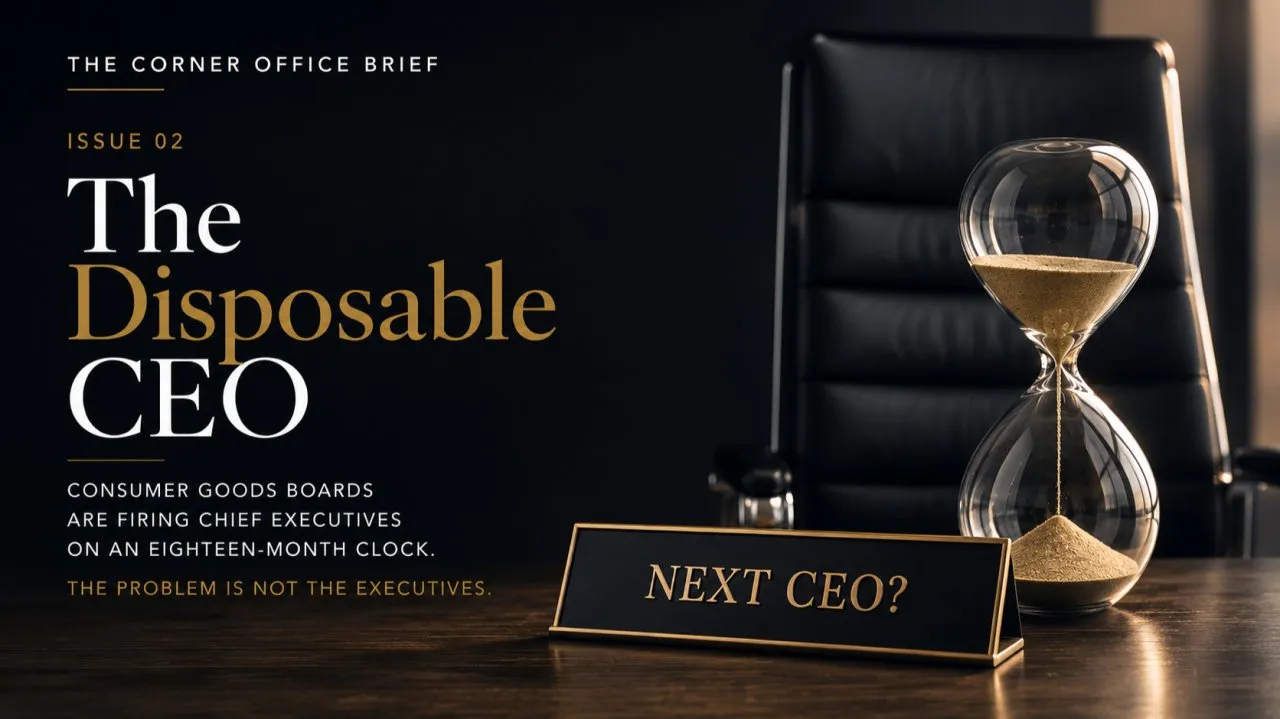
Consumer goods boards are firing chief executives on an eighteenth month clock. The problem is not the executives.
Three CEOs. Thirteen months. One company.
Since August 2024, Nestle has replaced its chief executive twice and lost the chairman who oversaw both exits. Mark Schneider was removed after weak sales. Laurent Freixe lasted exactly a year before leaving over an undisclosed relationship. Philipp Navratil was handed the keys the same day. The problem is not Nestle.
Unilever removed its CEO after twenty months. Diageo parted with hers at the two-year mark. Kenvue removed its chief executive twenty-six months after the IPO and is now being absorbed by Kimberly-Clark altogether. Kraft Heinz, exactly two years. Starbucks, seventeen months. When Heineken needed a successor this June, it poached the CEO of JDE Peet's, so now the coffee company needs one. Last year, seventeen percent of listed consumer companies changed their chief executive. No other sector came close.
The consumer sector has quietly invented a new executive role.
The Disposable CEO: a leader acquired for credibility, marked to market every quarter, and sold before the strategy has had time to work.
I have sat across the table from enough boards to know the standard explanation: we keep hiring the wrong people. Twenty years in executive search have taught me to distrust that sentence. When one company churns CEOs, you suspect the executive. When an entire sector churns them on a two-year cycle, the executives are not the variable. The system is.
Let me argue the other side first, because it is stronger than it looks. Some of these firings were simply correct. Freixe broke a conduct rule; the board had no choice and moved in a day. Schneider had seven years of runway before it acted, hardly impatience. And when Starbucks swapped a struggling CEO for a proven operator, the market roared its approval. A board that watches value erode for years out of politeness is not patient. It is negligent.
So the quick trigger is not the disease. Look closer and a cleaner dividing line appears: what happened the day after. Nestle named its successor within hours. Coca-Cola announced its transition a full quarter ahead, promoted its chief operating officer, and the market barely blinked, which is precisely the point. Meanwhile Diageo ran on an interim for months while it searched outside, and Lululemon's chair sat effectively vacant for over half a year between CEOs. The failure is not firing. The failure is being surprised.
The obvious question is why so many boards are surprised. Follow the incentives to the real villain, which is not sitting in the boardroom. Public markets have largely lost the ability to reward long-term consumer transformation. A product takes up to two years to travel from concept to shelf. A brand compounds over decades. A supply chain redesign is a five-year capital programme. The market grades all of it quarterly, and last year it graded the sector brutally: consumer staples returned 3.3 percent against the S&P 500's 15.9.
Into that gap moved the activists. Elliott Management extracted plant closures and margin commitments from PepsiCo within months. A crowd of funds pushed Kenvue into a sale. Campaign counts are rising again this year.
A board caught between a decade-long transformation and a ninety-day report card needs to show the market something. Strategy takes years. A CEO change takes a press release. Firing the chief executive has become the most liquid asset in the governance toolkit, the one thing a board can always sell. Reuters now describes consumer companies changing CEOs as fast as sports teams change coaches. The comparison is meant as an insult. Most boards have taken it as an instruction.
Wall Street ran the experiment in public. Starbucks spent months searching for its next leader, hired Laxman Narasimhan, and fired him seventeen months later. On the day Brian Niccol was announced as his replacement, the stock rose 24.5 percent, the best single trading day in the company's history.
Niccol had not yet changed a menu. Had not redesigned a store. Had not hired a single executive or served a single customer. Yet the market had already declared the turnaround complete, adding more than twenty billion dollars of value on his name alone; Bloomberg counted the swing at twenty-seven billion once Chipotle's same-day fall was included. One name, one press release, twenty-plus billion dollars. Boards that treat succession as an HR formality are mispricing the largest capital allocation decision they own.
Then came the part the celebration missed. By early this year the rally had faded as the turnaround ground on slower than hoped. An announcement buys credibility. It does not buy results. The same market that pays billions for the right name takes it back when the eighteen-month clock starts again.
One number explains the cycle better than any firing: in a recent analysis of consumer-company boards, nearly half of directors admitted they either have no CEO succession plan or are not sure one exists. About half doubted they could name an internal successor immediately. So boards with no bench fire under pressure, reach outside in a hurry, and hand the hardest job in the sector to someone doing it for the first time, which described seventy-eight percent of incoming consumer CEOs last year. The base rates say many will be back in the market within two years, and the cycle runs again. A Harvard Business Review analysis put the cost of badly managed transitions at close to a trillion dollars a year across the S&P 1500.
In January 1999, Procter & Gamble handed the company to Durk Jager, a hard-charging change agent with a mandate to transform everything at once. Seventeen months later he was gone, after a profit warning vaporised a third of the share price in a single day. The parallel with today is almost eerie, down to the number of months.
What matters is what P&G did next. It did not conclude that it had hired the wrong man and go shopping for a saviour. It concluded that it had built the wrong system. The unglamorous insider who took over, A.G. Lafley, narrowed the mandate, and the company spent the next twenty-five years building the deepest succession bench in the industry. Every P&G chief executive since has been promoted from within, and its transitions have mostly been non-events. The cure has been on the shelf for a quarter of a century.
The conversation usually starts the same way. "We need a transformational CEO," the board says. Then the brief arrives, and it asks one person to rationalise the portfolio, redesign a tariff-exposed supply chain, manage an activist and reignite volume, all in eight quarters.
They are not describing one CEO. They are describing four.
Nobody survives a job description written as an apology for the last firing.
And the talent can read base rates. In that same board analysis, sixty-five percent of next-generation consumer leaders said they do not want the CEO job. They are not less ambitious than the generation before them. They have watched the tape. The Disposable CEO does not just cost the company its leader. It quietly costs the company its pipeline.
If you sit on a consumer board: decide which two transformations actually matter and write them down before you open the search; build the bench in the good quarters, because a succession plan drafted during a crisis is a ransom note; and never let the chair sit empty while you shop.
If you are offered one of these seats: diligence the board harder than they diligence you. Ask how the last CEO's mandate was defined, and by whom. Ask what the activist has been promised. Ask for the succession plan below you, because its absence is how your predecessor ended up alone. The eighteen-month CEO is usually not a failure of competence. It is a casting error that was visible before day one, to anyone who asked.
The tragedy is not that CEOs are failing faster. It is that boards have begun confusing motion with leadership. Every dismissal reassures investors that somebody is accountable. Every rushed appointment postpones the harder question, which is whether the board itself is governing for the next quarter or the next decade. The companies that break the cycle will not be the ones that get better at firing. They will be the ones that make firing rare, boring, and planned years in advance.
In succession, boring is the whole prize.
Free: the Axentia Global Board Guide series. Practical guides to board roles, candidacy and the boardroom. Browse the guides
The finance route to the corner office in Europe has widened from one new chief executive in twenty to roughly one in five in three years, and the world's biggest carmaker by vehicles sold made the sa
Read article→
Private equity hired chief executives for a three-to-five-year race to exit. The exits stalled, holds stretched past seven years, and sponsors are now swapping leaders mid-race. The numbers show one c
Read article→
Companies are closing at record rates while still profitable, most led by owners over seventy with no one named to take over. The gap between a business with a ready successor and one without now has
Read article→