The CEOs of 2040 Are Not Being Hired
Companies are cutting the entry level jobs that quietly train their future leaders. The first bill arrives in 2030.

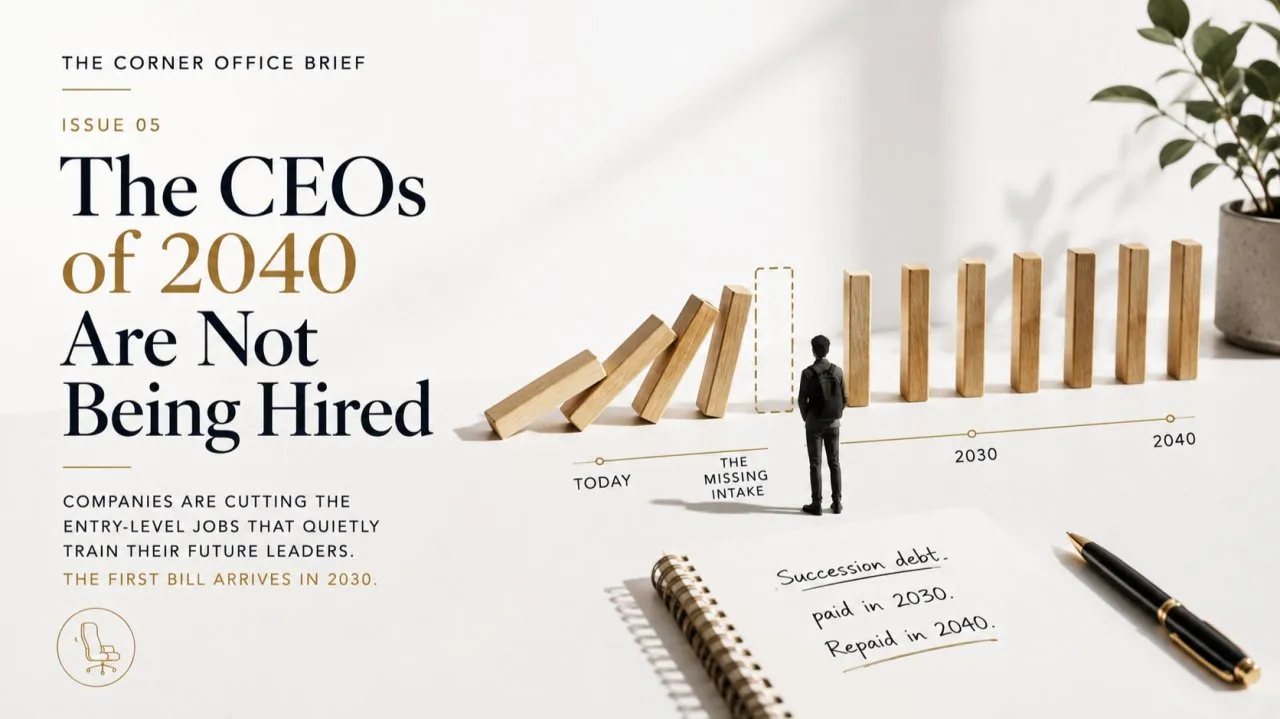
Companies are cutting the entry level jobs that quietly train their future leaders. The first bill arrives in 2030.
In 1986 the price of oil collapsed, and the industry did the sensible thing. It stopped hiring.
Between 1982 and 2000, the energy sector shed close to half a million jobs, according to Oil & Gas Journal. Roughly a quarter of its engineers and geologists left. For fifteen years, almost no young person entered the business.
Then oil went back to a hundred dollars, and the industry discovered what it had actually cut.
By the 2010s the reckoning had a name: the Great Crew Change. By one 2015 estimate, 71 percent of the energy workforce was over fifty, and one oilfield services giant predicted a shortage of fifteen thousand experienced engineers and geoscientists. Companies begged retirees to stay and paid whatever the shrinking pool asked, and still could not buy what they needed: twenty years of experience nobody had made.
The savings of the 1980s were repaid in the 2000s, with two decades of interest.
I have been thinking about that story all month, because corporate America is making a version of the same trade again. The trigger this time is not an oil price. It is artificial intelligence. And today's version is stranger: the companies cutting the first rung are not desperate. They are profitable, and choosing this.
Earlier this month, Stanford's Digital Economy Lab updated the most careful study we have of AI's effect on jobs, built on the payroll records of ADP, one of the largest payroll processors in the United States. Employment of workers aged 22 to 25 in the most AI-exposed occupations now stands about 19 percent below where it would be if it had simply kept pace with their peers in less-exposed work. A year ago the gap was 15 percent. It is widening.
Read one line deeper. Experienced workers show no comparable gap, and the adjustment is happening, in the researchers' words, primarily through reduced hiring of young workers rather than increased separations.
The experienced are not being displaced. The young are simply not being let in.
Two cautions before you quote that in a board meeting. The authors call the finding descriptive, not proof of cause; remote work, interest rates and a cooling white-collar market pull on the same rope. But it is no longer one dataset: a US Census Bureau working paper this spring independently found employment of 22-to-24-year-olds down 12 percent in the industries and regions most exposed to AI, in the ten quarters after ChatGPT arrived — again through hiring that never happened. Whatever the mix of causes, the signal is hard to ignore.
A layoff makes headlines. A hiring decision that never happens makes no sound at all.
Call it what an accountant would, if accountants were asked: succession debt. Every trainee cohort a company does not hire this year is a borrowing against its own future leadership, repayable in about fifteen years, at whatever the market then charges, with interest.
The individual decisions are visible once you look. AI has been the leading stated reason for US job cuts for five straight months, per the outplacement firm Challenger, Gray & Christmas. In my own world, 55 percent of supply chain leaders told Gartner they expect agentic AI to reduce their entry-level hiring.
None of this is hidden. It is simply filed under efficiency, when some of it belongs under succession.
Be fair to the companies: their logic is not lazy.
Much of what entry-level jobs consisted of, the reconciliations, first drafts, data pulls and deck assembly, really is done faster and better by a model. Nor is the sky falling. Look at the rest of that Challenger report and total announced cuts fell in July to a two-year low, while hiring announcements ran 25 percent above last year. AI is shifting the labour market, as the firm puts it, not dismantling it.
The surveys even say the fear is backwards: in one late-2025 survey of more than 350 global public-company CEOs and 400 institutional investors, 67 percent of the chief executives said AI is increasing their entry-level headcount. Both things can be true at once, and probably are. A survey describes plans across a whole company; a payroll file describes what already happened in the particular jobs a model can do today. But when a stated plan meets a payroll file, twenty years of reference calls have taught me which to bet on.
The strongest version of the optimistic case is different, and deserves a hearing. Perhaps the old apprenticeship was simply badly designed. If a machine can build the spreadsheet, why should a twenty-two-year-old spend three years learning to build spreadsheets? Handled well, AI clears out the drudgery and pushes young people sooner into the work that actually makes judgment: customers, factories, negotiations, decisions they own. That would be a better first job than the one my generation had. I would like to believe it. What I cannot yet find is the company doing it at scale.
Still, each firm, taken alone, is behaving rationally. That is precisely what should worry you. So were the oil companies of 1986, and they at least had the excuse of a collapsed price. A decision that is correct for each company in each quarter can still be ruinous for all of them across a generation, because the market punishes overpaying for juniors this year and says nothing about having no leaders in 2040. It is the same trap that keeps first-time directors off boards: everyone wants experience, and no one wants to be where it is made.
And the deepest flaw in the efficiency logic is an accounting error. Companies never really paid graduates for their output. The output was the excuse. What the salary bought, without ever appearing on an invoice, was the slow manufacture of judgment: a thousand small reps of doing the work badly, being corrected, and doing it again. The apprenticeship was financed by inefficiency. Remove the inefficiency and you remove the apprenticeship, and no line item anywhere records the loss.
One more force presses on the same spot, from the same survey: 84 percent of the large-company CEOs said returns from new AI initiatives take longer than six months, while a majority of the investors expected them inside six. The space between those two numbers is where headcount goes. A cancelled graduate programme is the fastest AI return a chief executive can show an impatient market, and the cost lands two or three CEOs from now.
A new chief executive of a large company is typically in their mid-fifties, which means a career that began some thirty years earlier. The corner-office class of the 2040s is being hired, or not hired, right now, out of the cohort sitting 19 percent below trend.
At the top of the ladder, meanwhile, boards burned by inexperienced chief executives have swung back hard toward proven, repeat operators, as I wrote in the first issue of this Brief. Demand for verifiable experience is rising. Production of it is being cut. When demand rises into falling supply, an economist needs one guess about the price — and Gartner has already quoted the interest rate. It predicts that by 2030, three-quarters of the supply chain organisations pausing entry-level hiring this year will pay premiums of 15 percent or more for early-career professionals. Not 2040. 2030. The first payment on succession debt falls due within the tenure of the executives taking out the loan.
My industry, I should admit, will do fine out of this. Scarce executives are our product. That is exactly why you should not want the version of 2040 that is good for me.
Every brief that crosses my desk asks for fifteen to twenty-five years of operating history. The plant turned around. The network redesigned. The team rebuilt in a crisis. Clients specify it to the year, and they are right to. But in twenty years of searches, no client has ever asked me where those years get made. They get made in first jobs, and mostly inside the company that ends up promoting: three in five of last year's new chief executives at America's largest 1,500 listed companies were internal appointments, and at the biggest companies roughly three in four. So this is not a labour market doing something to companies. It is a production decision, taken at home. When I place a fifty-year-old chief supply chain officer, I am delivering a product whose line started in the late 1990s.
If you run a company: the question is not whether to use AI on junior work. You will, and you should. The question is what replaces the apprenticeship that work silently provided — and your own executives already know it needs an answer. In the same Gartner survey, 86 percent said agentic AI will force new ways of building the talent pipeline. So carve out a small apprenticeship lane and design it around what a model cannot absorb for you: walking the plant, sitting with customers, owning a number that matters. If you sit on a board, ask for one chart and one number: headcount by age band today versus five years ago, and how many of your open roles someone with no experience could still be hired into. If the base is thinning, you are looking at your succession plan for 2040, and it is blank. And if you are a senior operator: your verifiable experience is quietly appreciating, and the irreplaceable leaders of the next decade will be the ones who can still make successors.
The oil industry's mistake was never the layoffs of 1986; the price left no choice. The mistake was believing a hiring freeze was a saving, when it was a loan. Companies cutting the first rung today are taking the same loan without the same excuse. Delete a hundred junior roles and the saving books this quarter; the hundred missing operators of 2040 appear on no balance sheet, yours or anyone's, which is why the market rewards the cut and stays blind to the debt.
The savings are real. So is the debt. Only one of them is on the books.
Free: the Axentia Global Board Guide series. Practical guides to board roles, candidacy and the boardroom. Browse the guides

The finance route to the corner office in Europe has widened from one new chief executive in twenty to roughly one in five in three years, and the world's biggest carmaker by vehicles sold made the sa
Read article→
Private equity hired chief executives for a three-to-five-year race to exit. The exits stalled, holds stretched past seven years, and sponsors are now swapping leaders mid-race. The numbers show one c
Read article→
Companies are closing at record rates while still profitable, most led by owners over seventy with no one named to take over. The gap between a business with a ready successor and one without now has
Read article→