Senior Is Not the Same as Boardable
HR chiefs have never stood higher inside their companies, yet their new board appointments have halved in two years. The gap between senior and boardable is where most first board seats are lost.

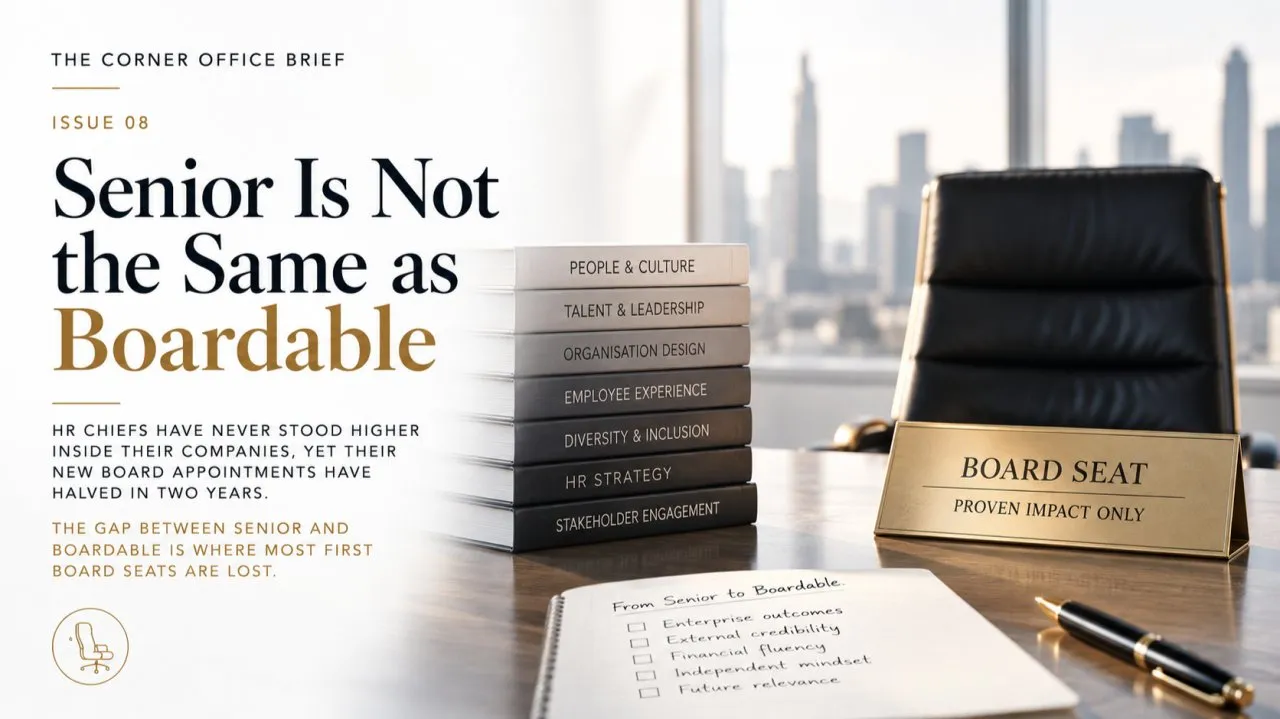
HR chiefs have never stood higher inside their companies, yet their new board appointments have halved in two years. The gap between senior and boardable is where most first board seats are lost.
The message lands in my inbox most weeks. A chief human resources officer, or a president of supply chain, twenty-five years of work behind them and a title their younger self would not have dared write down. The message says something like, I am ready for board work; keep me in mind.
Most of them will never get the call. Not because they are not senior enough.
Because seniority was never the question.
Look at what just happened to the HR chiefs. On 3 September 2026, Equilar, the executive-data firm, published a study of the Russell 3000. Chief human resources officers have never been more visible in their companies: 246 were disclosed as named executive officers in 2025, a record, up from 92 in 2021. Over the same period, new CHRO appointments to boards fell from 45 in 2023 to 21 in 2025. More than halved in two years, while their internal standing hit an all-time high.
Rising seniority. Falling seats. Whatever boards are buying, it is not rank.
One honest footnote: total CHRO representation still edged up, to 334 seats on Equilar's count; sitting directors keep their chairs. The flow of new invitations collapsed. My read: post-pandemic, talent sat at the top of every risk register, and boards bought its leaders; the register has since swung toward economic uncertainty, execution, and capital, and the invitations followed. Boards do not buy functions. They buy whatever the risk register says is missing.
Regular readers will remember the First-Seat Paradox from an earlier issue of this Brief: boards pay their highest premium for experience and refuse to be the place where anyone gets it. The 2026 numbers say the paradox is tightening. The long running S&P 500 board composition index put first-time directors at 31 percent of new appointments in 2025; its snapshot of the 2026 intake puts them at 24 percent. Run the arithmetic: 364 new directors this year, 24 percent first-timers, roughly ninety first-time seats in a year across the S&P 500. And the seats that did open went to the already proven: 37 percent of the 2026 intake are current or former chief executives, up from 30 percent a year earlier, and across the Fortune 500, 74 percent of last year's new directors already held public-board seats, per the most-watched annual study of board appointments. When committees get nervous, they buy what the market has already priced.
Here is the strange part. Boards are not closing the door because they feel well stocked. In the National Association of Corporate Directors' survey heading into 2026, only 33 percent of directors said they were strongly confident in their own board's collective skill set, and one in seven worried the capabilities for the year ahead are missing. Boards doubt their bench and still will not risk a newcomer, which tells you the screen is not about need.
It is about proof.
Executives manage their careers as a sequence of titles. Nominating committees do not buy titles. A committee choosing a director is placing a decade-long, publicly visible bet with other people's money, based on a few meetings a bet that is then hard to unwind. So it buys the only thing that reduces that risk: evidence.
Call the standard boardable. Boardable is not a level of seniority. It is a portfolio of evidence, assembled over years, that answers the questions a committee is quietly asking. Watching first seats get won and lost for two decades, I count five proofs. Most careers, including very senior ones, hold two or three.
One. The enterprise proof. Evidence that you have been accountable for outcomes owners care about: a P&L, a country, a turnaround with financial consequences. Not effort, outcomes. In the 2025 intake of S&P 500 directors, only one in ten was classified as a P&L leader, while three in ten were chief executives. The market is not buying people who once ran a number; it is buying enterprise judgment, and a cost center, however heroic, reads as effort. If your record cannot show ownership, the fix is not a better CV. It is a different next role.
Two. The witnessed proof. Somebody outside your own company a customer, a supplier, an investor, a joint-venture partner has seen your judgment under pressure and will say so. First seats rarely come from databases. They come from people who sat across a table from you in a hard negotiation and remembered. One caution: a 2024 study in the Journal of Operations Management found ecosystem directors create real value and real conflicts. The witnessed proof only converts when your independence is beyond argument.
Three. The fluency proof. You can read a balance sheet, an audit report, and an incentive plan as a director must, without the finance team translating. Committees over-buy finance CVs 29 percent of that same intake because finance is immediately deployable: 45 percent of new Fortune 500 directors land first on the audit or finance committee, per the same study. Fluency is how a non-finance executive neutralizes that advantage. It is the cheapest proof on the list to build, and the most often skipped.
Four. The agenda proof. Your expertise has to map to what is on the board's risk register now, not what was on it when you were promoted. Watch the fastest-inflating credential in governance: 37 percent of S&P 500 companies now cite AI experience for at least one director, up from 11 percent in 2022, per EY's review of the 2026 proxy season, while only 5 percent of directors actually carry it. Agendas are moving faster than guest lists, and a 2026 survey of nominating committee chairs confirms it: 78 percent expect new skills to drive their next refreshment, with AI leaping to the top of the digital wish list 73 percent, from 33 a year earlier. Read that as a first-timer. You will not beat experienced directors at being experienced. You get in when the board needs something its experienced directors don't have stated in the board's language: risk, capital, oversight.
Five. The apprenticeship proof. A governance record that existed before the vacancy did: a subsidiary board, a joint venture, a family-owned company, an industry body with a real budget. Unglamorous rooms, same muscles. With first-timers down to 24 percent of the intake, a committee taking a chance on you needs evidence that somebody else took the chance first. The executives who win first seats at 55 usually started collecting this proof at 45.
Every time I make this argument, somebody senior replies: it is a network game; just get known. And the network matters; the witnessed proof is a network, formalized. But the belief that visibility substitutes for evidence is exactly the mistake the CHRO data exposes. Named-executive status is visibility. It rose 167 percent, while the new seats halved. A network converts evidence into an invitation. It cannot convert seniority into evidence, because the committee's risk doesn't care how many people know your name.
Be fair to the committees too. Sitting directors are re-elected with roughly 96 percent shareholder support, and contested removals are vanishingly rare; a board seat is a sticky asset in a low-turnover market. The committees' caution is not snobbery. It is the rational price of that stickiness, which is why the burden of proof sits, unfairly but immovably, with the candidate.
The pattern I trust most: the executives who get the first call are the ones a client mentions when we are not discussing board seats at all. The chief procurement officer a former supplier wants on its board, because they spent ten years being tough and fair across the table. The operations president the private-equity firm remembers from a diligence process that went sideways. Nobody in those rooms was auditioning. That is why it counted.
And the sequence I have watched for twenty years still holds: the first seat is brutally hard, and the second, third and fourth come far more easily. Before the first, a committee is asked to imagine you as a director. After it, the market has evidence. Which is the entire thesis in one sentence.
So do the audit honestly. Score yourself against the five proofs today, in writing. If you are at two, you do not have a visibility problem. You have an evidence problem, and evidence usually takes deliberate years to build: a role with a number attached, a committee seat in an unglamorous room, a hundred hours with the balance sheet.
Seniority is what your company gave you. Boardable is what you can prove to strangers with their own money on the table.
The title on your card says how far you rose. The proofs say whether you should be trusted with someone else's company. Boards stopped confusing the two long ago. The executives who want their seats should stop as well.
Free: the Axentia Global Board Guide series. Practical guides to board roles, candidacy and the boardroom. Browse the guides

The finance route to the corner office in Europe has widened from one new chief executive in twenty to roughly one in five in three years, and the world's biggest carmaker by vehicles sold made the sa
Read article→
Private equity hired chief executives for a three-to-five-year race to exit. The exits stalled, holds stretched past seven years, and sponsors are now swapping leaders mid-race. The numbers show one c
Read article→
Companies are closing at record rates while still profitable, most led by owners over seventy with no one named to take over. The gap between a business with a ready successor and one without now has
Read article→